
How to Choose a Nail Academy in the UK: 9 Things to Check Before Booking a Nail Course
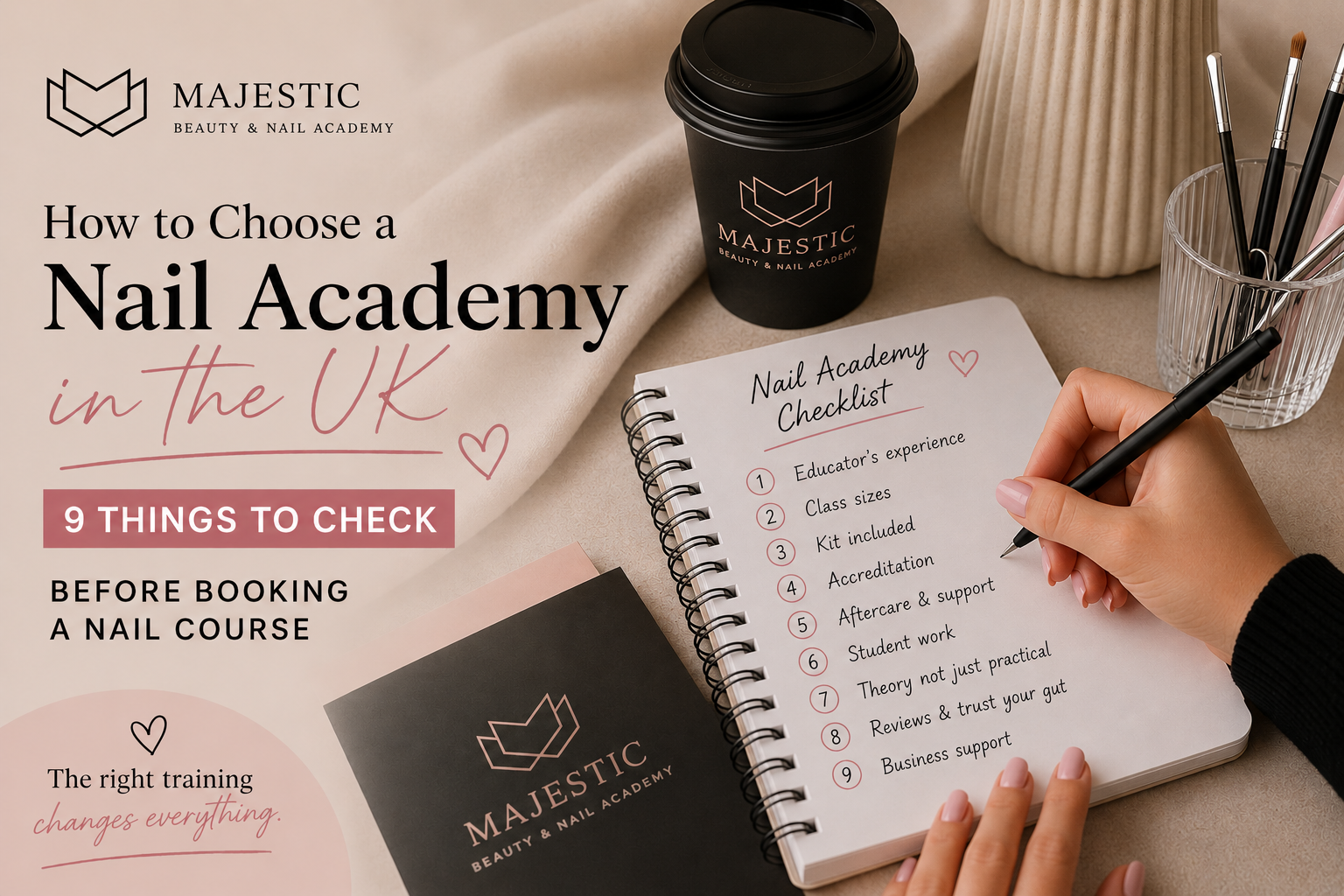
Choosing a nail academy is one of the biggest decisions you'll make at the start of your nail career. Get it right, and you'll walk away with the skills, confidence, and certification you need to start working on real clients. Get it wrong, and you'll waste hundreds of pounds on training that leaves you more confused than when you started.
We say this from experience. At Majestic Academy, many of our students have already been trained elsewhere before coming to us. Some have been to two or three other academies. They arrive feeling frustrated, thinking they're the problem because they're just not good enough to do nails. But when we go back to basics with them, we almost always find the same thing: they were never taught properly in the first place.
The nail training industry in the UK offers a wide range of options, from further education colleges and regulated VTCT qualifications to private academies offering accredited short courses. This is great for accessibility, but it also means the quality of training can vary significantly between providers.
Some academies are run by experienced educators who have spent years working on real clients and developing their teaching skills. Others may have trainers with limited hands-on experience or course content that doesn't fully prepare students for professional work. The difference isn't always obvious from a website or an Instagram page.
That's why doing your research before booking is so important. Here are 9 things to look for before you hand over your money.
1. Check the Educator's Real-World Experience
This is the most important one. Your trainer should have years of hands-on experience working on real clients, not just a teaching certificate and an Instagram page. Ask them directly: " How long have you been doing nails professionally? Do you still work with clients? What systems do you specialise in?
A trainer who is still actively working in the industry will teach you things that someone who only learned from a textbook simply cannot. Real-world experience means they've dealt with every nail type, every problem, every difficult client. That knowledge gets passed on to you.
Be cautious of academies where the trainer has limited hands-on experience. Teaching requires deep knowledge, and that takes time to develop.
2. Ask About Class Sizes
This matters more than most people realise. If you're in a class of 15 or 20 students, how much one-to-one attention are you really going to get? The answer is: very little.
Smaller classes mean your trainer can watch your technique closely, correct your mistakes in real time, and make sure you actually understand what you're doing before you move on. You should be getting hands-on guidance, not sitting at the back of a room watching a demonstration you can barely see.
At Majestic Academy, we keep our classes to a maximum of 4–6 students. Every student gets individual attention throughout the entire course.
3. Find Out What's Included in the Kit
Some academies charge hundreds of pounds for a course and then expect you to buy all your own products on top. Others include a kit but fill it with cheap, low-quality products that you'll need to replace immediately.
Before booking, ask exactly what's included. Is it a full professional kit with everything you need to start practising and working on clients? Or is it a handful of basics that won't get you very far?
A good academy invests in giving you the right tools from day one because they know the products you train with affect the quality of your work. At Majestic Academy, every course includes a full professional kit so you can start working on clients straight away.
4. Check the Accreditation and Understand What It Means
Accreditation matters because it affects your insurance. Without the right accreditation, you may struggle to get insured, and without insurance, you cannot safely or professionally work with clients.
But not all accreditations are equal. Ask who the accrediting body is and whether the qualification is recognised by major insurance providers. Don't just take the academy's word for it; do your own research. You can verify qualifications on the Ofqual Register of Regulated Qualifications (https://register.ofqual.gov.uk) or check with insurance providers like ABT (https://www.abt.org.uk) or Babtac to confirm whether a particular certificate will be accepted.
Be wary of academies that are vague about their accreditation or use language that implies their certificate is more official than it actually is.
5. Ask About Aftercare and Ongoing Support
Your learning doesn't stop when the course ends. In fact, the hardest part often comes after when you're on your own, practising at home or working on your first clients, and you run into problems you don't know how to fix.
A good academy doesn't just hand you a certificate and disappear. They offer ongoing support so you can ask questions, send photos of your work for feedback, and get help when you're stuck.
Also, ask about student discounts. If you've trained with an academy, you should be able to access the professional products you learned with at a fair price, not be left searching for them on your own.
At Majestic Academy, every student gets ongoing support through WhatsApp and email after their course. If you're struggling with something three weeks or three months later, we're still here to help. Our students also receive a lifetime discount code to purchase professional products on our website at www.majesticacademy.uk, so you can keep using the products you were trained on, at a price that helps your business grow.
6. Look at Student Work, Not Just the Trainer's Work
Every academy will show you beautiful photos of their trainer's nails. Of course, they look good; they've been doing it for years. What you really want to see is what the students are producing by the end of the course.
Ask to see photos or videos of actual student work. Check the academy's tagged posts on Instagram. Read reviews from real students. This gives you a much more honest picture of the quality of training than a polished website ever will.
7. Make Sure the Course Covers Theory, Not Just Practical
A course that only teaches you how to apply a product without explaining why is setting you up for problems. You need to understand nail anatomy, hygiene and safety, contraindications, product chemistry, and proper removal techniques.
This theoretical knowledge is what separates a confident professional from someone who's just copying what they saw on YouTube. It's also what keeps your clients safe.
If a course promises to teach you everything in just a few hours with no theory component, that's a red flag. Proper nail training takes time.
8. Trust Your Gut and Read the Reviews
If something feels off when you enquire, slow responses, vague answers, pressure to book immediately, no clear information about what's included, trust that instinct.
Read reviews on Trustpilot, Google, and social media. Look for specific comments about the quality of teaching, not just generic "great course" reviews. Pay attention to what students say about how they felt after the course. Did they feel confident? Could they actually do nails independently? Did they get support when they needed it?
9. Do They Help You Build a Business or Just Teach You a Skill?
This is the one most people don't think about until it's too late. You finish your course, you've got your certificate, your kit, your skills and then what? How do you actually get clients? How do you price your services? How do you market yourself?
Learning how to do nails is only half the journey. The other half is building a business around it. And most academies don't touch this at all. They teach you the technical skills and leave you to figure out the rest on your own.
Look for an academy that cares about what happens to you after you leave. Do they offer guidance on setting up your business? Do they help you with marketing, even just the basics of getting your first clients? Do they give you a realistic picture of what it takes to turn your qualification into an actual income?
At Majestic Academy, we help our students with business startup advice and marketing guidance because we know that a certificate alone doesn't pay the bills. We want our students to succeed not just as nail technicians, but as business owners.
The Bottom Line
Not all nail academies are the same. The price of a course doesn't always reflect the quality, and a certificate on the wall doesn't always mean you've been properly trained.
Do your research. Ask the hard questions. And choose an academy that will genuinely invest in your education, support you after you qualify, and help you build a real career not just take your money and send you on your way.
If you're searching for a nail academy in London or nail courses near you, take the time to check these 9 things before booking. The right training changes everything.
If you're considering training with us at Majestic Academy, we're always happy to answer any questions before you book. No pressure, no hard sell just honest advice about whether our courses are the right fit for you.
DM us on Instagram @majestic_beauty_nail_academy www.majesticacademy.uk
Frequently Asked Questions
How much does a nail course cost in the UK?
Nail courses in the UK typically range from £150 to over £1,000 depending on the system, the length of training, and what's included. Be cautious of courses that seem unusually cheap; if the price looks too good to be true, it usually is. Always check what's included in the fee. At Majestic Academy, all our courses include a full professional kit, training manual, certification, and ongoing support.
Do I need qualifications to be a nail technician in the UK?
There is currently no legal requirement to hold a qualification to work as a nail technician in the UK. However, you will need an accredited certification to get insurance, and without insurance, you cannot safely or professionally work for paying clients. Always check that your course is accredited by a body recognised by major insurance providers.
How long does it take to become a nail technician?
This depends on the course you choose. Short, accredited courses can take one to five days or 21 days for all courses for a specific system like BIAB, gel, or acrylic, etc. A full VTCT Level 3 qualification (https://www.vtct.org.uk) takes several months. What matters more than the length is the quality of what you're taught and the support you receive afterwards.
Can I learn nails from YouTube or online courses?
You can learn some basics online, but it's not a replacement for hands-on training with a qualified educator. Watching a video doesn't give you feedback on your technique, correct your mistakes, or teach you how to handle real client situations. If you're serious about working professionally, invest in proper in-person training.
What should I look for in a nail academy?
Look for experienced educators, small class sizes, accredited qualifications, a professional kit included, ongoing aftercare support, student product discounts, business startup guidance, and real student reviews. Read our full guide above for the 9 things every student should check before booking.
What's the difference between accredited and regulated nail qualifications?
Accredited courses are recognised by professional bodies and allow you to get insurance to work with clients. Regulated qualifications, such as VTCT Level 3, are overseen by Ofqual and follow national occupational standards. Both can lead to a successful career; what matters most is the quality of the training and the educator's experience.